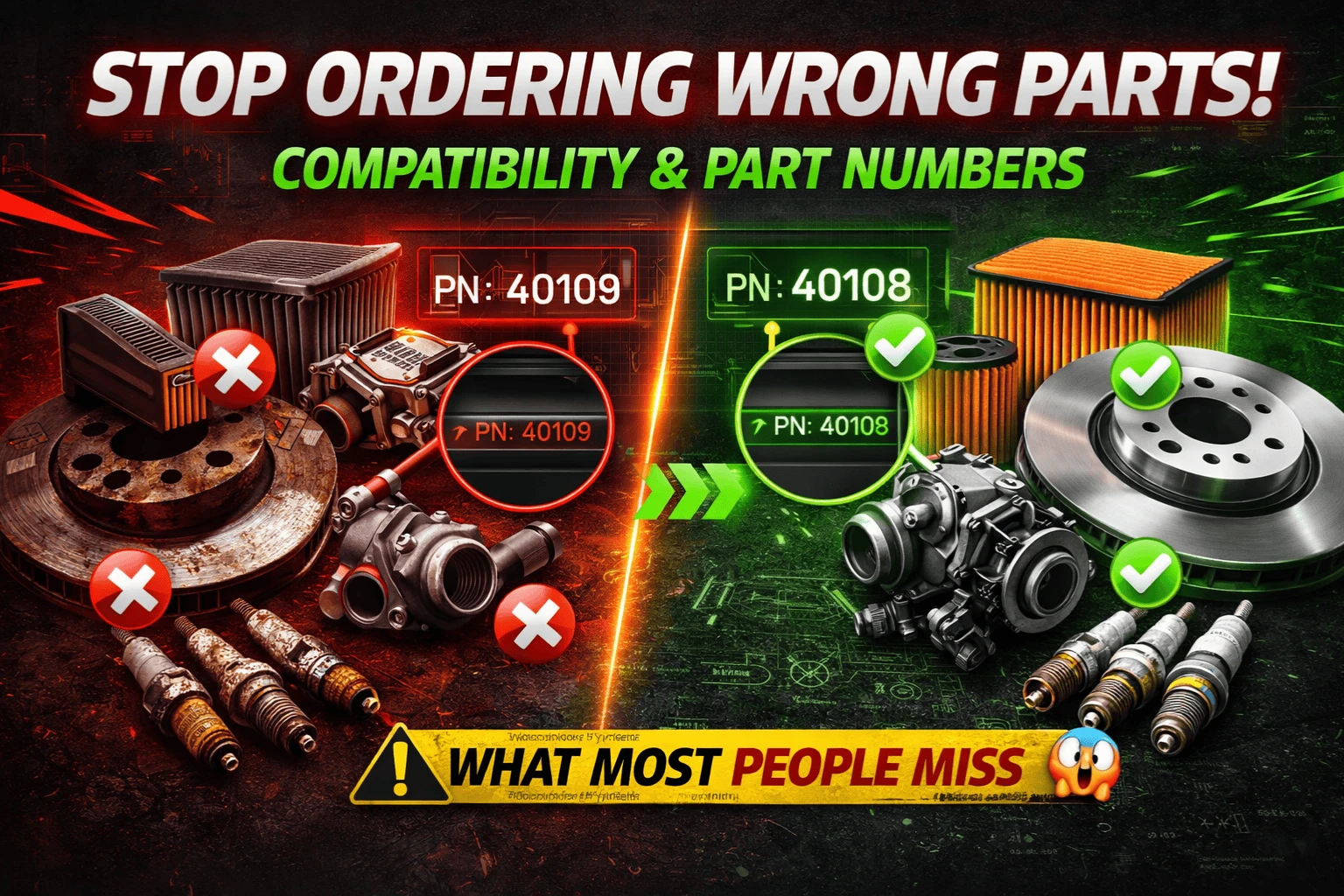
The Complete Guide to Ordering Auto Parts Online: Compatibility, Part Numbers & What Most People Miss
Introduction
Here's how it usually goes: you find the part, you check the make, model, and year, you hit order. Three days later, the box arrives, and the part is almost right, wrong connector, slightly different bracket, incompatible sensor thread. Return shipping. Waiting. Frustration.
That scenario plays out thousands of times daily. Not because the buyer was careless, but because ordering auto parts online is genuinely more nuanced than most guides admit.
Your car's "year" isn't always what determines compatibility. Your "model" might have six variants that share a name but nothing else under the hood.
This guide fixes that. Whether you're ordering a timing belt tensioner, a headlight assembly, or a brake calliper, you'll know exactly what information to pull together before you ever open a parts website.
We'll cover VIN decoding, part numbers, quality tiers, what "universal fit" actually means, and a few traps that catch even experienced mechanics off guard.
What you'll walk away knowing:
- Why your VIN tells you more about fitment than the year on your registration
- The exact seven data points any reputable parts supplier will need
- How OEM, OES, and aftermarket quality grades actually differ — and when each is the right call
- How to spot a counterfeit part before it arrives at your door
- Common ordering mistakes and how to avoid them completely
Let's get into it.
Why Ordering Auto Parts Online Goes Wrong More Often Than It Should
Before building the checklist, it's worth understanding the root cause of most wrong-part orders. It almost always comes down to one of three things:
1. Model year ≠ production date. Manufacturers update parts mid-cycle. A 2021 Toyota Camry built in January and one built in October may use entirely different part numbers for the same component, because a running production change happened in July. The listing says "2021 Camry." Both cars are 2021 Camrys. Only one part fits.
2. Trim confusion. A "base" Corolla and a "Sport" Corolla are the same car on paper, but the suspension geometry, brake package, sensor wiring, and even the engine mounts can differ. When a listing says "fits all 2020 Corolla," someone made an assumption.
3. Part number supersession. Manufacturers update part numbers when they revise components. Your part number from a 2019 repair manual may have been superseded twice since then. The old number still exists in some databases; it's just pointing to an outdated version of the part.
None of this is the buyer's fault. The fix is having the right information before you search, not after you receive a box.
The 7 Pieces of Information You Need Before Ordering
1. Your Full 17-Digit VIN
This is non-negotiable. The Vehicle Identification Number is a standardised 17-character code that encodes:
- Country and plant of manufacture
- Manufacturer
- Vehicle type and restraint systems
- Model line, series, body style
- Engine type
- Check digit
- Model year
- Assembly plant
- Sequential production number
That last group, the sequential production number, is what lets a good parts supplier identify exactly which build run your car came from, including any mid-cycle production changes.
Where to find your VIN:
- Driver's side dashboard, visible through the windshield (most common)
- Driver's side door jamb sticker
- Vehicle registration and insurance documents
- Engine bay stamp (varies by manufacturer)
- Under the spare tyre in the trunk (some models)
Don't just type your year, make, and model into a parts site and assume you're done. Many platforms show the VIN field as optional. It isn't. Using the VIN takes 20 seconds. Re-ordering a wrong part takes days.
2. Your Exact Trim Level
This trips up more buyers than any other single factor. Trim level affects:
- Suspension components (sport trims often have different spring rates, strut mounts, and sway bar diameters)
- Brake systems (larger rotors and callipers on higher trims)
- Engine variants (a "2.0T" and "2.5" in the same model line share almost nothing in the drivetrain)
- Electronics and sensor packages (advanced driver assistance systems use different wiring harnesses)
- Transmission type (some trims offer both automatic and manual, not interchangeable)
Your trim level is printed on:
- The rear of the vehicle (badge)
- The door jamb sticker
- Your vehicle registration in most countries
- Any dealer service records
Common trim naming conventions to be aware of: SE, LE, XLE, Sport, Base, Limited, Premium, S, SV, SL, Titanium, Platinum, GT, GTS, STi, Type R. These are not cosmetic differences on many platforms. They drive completely different parts with compatibility.
3. Your Exact Engine Specification
"V6" is not enough. You need:
- Displacement (e.g., 3.5L, not just "V6")
- Engine code (e.g., 2GR-FE, EA888, N55, K24Z7) this is what parts databases actually use
- Fuel system type (naturally aspirated, turbocharged, supercharged, hybrid)
- Fuel type (petrol/gasoline, diesel, LPG, hybrid)
The engine code is usually stamped directly on the engine block. It also appears on the door jamb sticker on most modern vehicles, and some manufacturers include it in the VIN itself (positions 4–8 vary by manufacturer).
If you can decode the VIN online (free tools from NHTSA, VINDecoderz, or manufacturer portals), you'll see the engine code explicitly, no guesswork.
4. Transmission Type
For any drivetrain, clutch, mount, or sensor-adjacent part, you need:
- Manual / Automatic / CVT / DCT / AMT
- Number of speeds (6-speed, 7-speed, 8-speed, 10-speed)
- 2WD / 4WD / AWD / 4x4
This matters far beyond "transmission parts." Engine mounts, transfer cases, driveshafts, sensors, and even exhaust hangers vary between drivetrain configurations. The same model year, same trim, same engine, different if one is AWD and one is 2WD.
5. The Build Date (Not Just the Model Year)
This is the one most people skip, and the most common cause of mid-production-cycle fitment failures.
The build date is typically found on:
- The door jamb sticker is usually printed as MM/YYYY or Month/Year
- The firewall sticker in the engine bay
- The VIN decode includes a production date field
The rule: if you're ordering a part for a vehicle near the start or end of a model year, always verify the build date. Production changes frequently happen mid-year, and the official model year is just an administrative label.
6. The OEM Part Number (If You Already Have It)
If you're replacing a part that's already on the car, the fastest and most reliable sourcing method is the OEM part number stamped or labelled on the component itself.
Look for this on:
- Adhesive labels on sensors, modules, and electronics
- Cast markings on metal components (brake callipers, alternators)
- Embossed numbers on rubber components (belts, hoses)
With an OEM number, you can:
- Search it directly on the manufacturer's parts catalogue (most OEMs have public-facing portals)
- Find compatible aftermarket equivalents using cross-reference databases
- Verify that superseded numbers exist and find the current replacement
Note: If an OEM number has been superseded, the newer number is the one you want. Both may "exist" in a supplier's database, but only one reflects the current specification.
7. Your Geographic Market / Vehicle Specification
This is particularly relevant for imported vehicles and for buyers in markets like the UAE, where a significant percentage of vehicles are JDM (Japanese Domestic Market), US-spec, European-spec, or GCC-spec versions of the same model.
A GCC-spec Toyota Land Cruiser and a JDM Land Cruiser share a nameplate and very little else when it comes to certain emissions components, cooling systems calibrated for climate, and electronics.
Always confirm:
- Country of origin of your specific vehicle (visible in VIN positions 1–3 and on the door jamb sticker)
- Market specification (GCC, EU, US, JDM, etc.)
- Any regional modifications performed by the dealer or importer (sometimes, entire wiring looms differ)
OEM, Aftermarket, and Everything In Between: The Quality Tier Breakdown
One of the most misunderstood decisions in auto parts purchasing is the choice between OEM and aftermarket. The reality is more nuanced than most guides describe. There are actually four meaningful quality tiers:
| Tier | What It Is | When to Use It | Price Premium |
| OEM (Original Equipment Manufacturer) | Made by the same factory that supplied your car's manufacturer. Identical spec to what came off the assembly line. | Safety-critical components, luxury vehicles, warranty-sensitive repairs | Highest |
| OES (Original Equipment Supplier) | Made by the same supplier as OEM, but sold under their own brand (e.g., Bosch, Denso, Valeo, ZF) rather than the car brand's badge | Almost all situations — excellent value, identical quality | 20–40% less than OEM |
| OEM-Equivalent / Premium Aftermarket | Made to match or exceed OEM spec, often by established brands (Gates, Monroe, Bilstein, NGK) | Most maintenance and repair applications | Moderate savings |
| Economy Aftermarket | Generic manufacturing, minimal quality control, typically from low-cost producers | Non-structural cosmetic parts, consumables in non-critical applications | Lowest |
The dirty secret of the parts industry: Many "OEM" boxes you buy from a dealer contain parts made by the same third-party supplier who also sells under their own brand at a fraction of the price.
A genuine Bosch fuel pump at an auto parts store may be physically identical to the "OEM" Bosch-made pump in the manufacturer's branded box at 35% of the cost.
The important distinction: Never use economy aftermarket on safety-critical components. Brakes, steering components, suspension joints, airbag systems, and fuel delivery parts should be OEM, OES, or premium aftermarket only.
The "Universal Fit" Problem
"Universal fit" is a phrase that does a lot of harm. It sounds like a feature. It's actually a limitation dressed up as one.
A universal-fit part is designed to physically attach to multiple vehicles with minor modification. It is not validated to perform identically across all of them. For:
- Exhaust components: A universal catalytic converter or muffler may fit, but emissions performance, flow rate, and thermal characteristics will differ from vehicle-specific units.
- Air filters: A universal-style intake filter is fine. A universal-fit mass airflow housing is not.
- Wiring harnesses and sensors: Never universal. These must match your vehicle's exact specification.
- Struts and shocks: If it says "universal," it means the mounting pattern might work. The valving, travel, and spring rate may be completely wrong for your vehicle's geometry.
The practical rule: universal fit is acceptable for low-stakes, non-structural parts. For anything load-bearing, safety-critical, or electronically integrated, insist on vehicle-specific fitment.
MYTH VS. FACT: Auto Parts Edition
These questions generate consistent "People Also Ask" appearances; they're worth knowing cold.
Myth: Aftermarket parts void your vehicle warranty. Fact: In most markets (including the EU under block exemption regulations and the US under the Magnuson-Moss Warranty Act), using aftermarket parts does not automatically void your warranty. A manufacturer must demonstrate that the specific aftermarket part caused the failure to deny a warranty claim. Using a quality aftermarket oil filter does not void your engine warranty. [This area does vary by jurisdiction; check local consumer protection law for certainty.]
Myth: The same part number from different suppliers is the same part. Fact: Part numbers are cross-referenced, not standardised globally. An aftermarket part listed as "equivalent to OEM # 12345-ABC" has been cross-referenced by the aftermarket supplier, but quality, tolerance, and material spec can vary significantly from the original. The number is a reference point, not a quality guarantee.
Myth: If the part physically fits, it will work correctly. Fact: Fitment and function are different things. A brake calliper from a slightly different variant may bolt up perfectly but have a different piston diameter, delivering incorrect clamping force. A sensor with the same connector may have different signal output characteristics that confuse your ECU. Always verify full compatibility, not just physical fit.
Myth: Buying from a marketplace platform guarantees authentic parts. Fact: Major platforms, including Amazon, eBay Motors, and others, have documented counterfeit parts problems. [Reported by the US Department of Transportation, 2023 counterfeit auto parts market estimate: $3B+ annually.] Buying from verified/certified suppliers who can provide traceable supply chain documentation is the only reliable protection.
Myth: New means better than remanufactured. Fact: Remanufactured parts, particularly for starters, alternators, steering racks, and turbochargers, are often rebuilt to OEM spec using original core components and may outperform cheap new equivalents. Reputable remanufacturers (Cardone, Standard Motor Products, Bosch Reman) carry warranties comparable to new parts.
How to Spot a Counterfeit Auto Part
Counterfeit parts have entered the supply chain at every level. Even reputable-looking online storefronts carry them unknowingly. Here's what to check:
Before ordering:
- Verify the seller has a traceable supplier chain, not just "authorised dealer" self-labelling
- Look for brand-specific holograms or QR authentication in product listings (many OEM brands now use these)
- Check reviews specifically for "wrong fitment," "failed quickly," or "looks different from photos" These are counterfeit red flags
When the package arrives:
- Compare packaging quality to manufacturer standards. Legitimate OEM boxes have consistent print quality, correct logos, and no spelling errors
- Weigh the part if possible, counterfeits frequently use inferior materials that are noticeably lighter than spec
- Check for OEM part numbers and date codes on the part itself. Legitimate components are stamped or laser-etched
- For sensors and electronics: check the connector quality, wire gauge, and potting compound. Cheap counterfeits cut corners on all three.
If something seems off: Don't install the part. Contact the supplier immediately. A wrong or counterfeit safety component that fails at 120 km/h is not a return issue.
The Pre-Order Checklist (Quick Reference)
Before you hit "Add to Cart" on any auto part, confirm you have:
- Full 17-digit VIN
- Exact trim level (not just "Sport", the full designation, e.g., "2.5 SE Sport")
- Engine code (not just displacement, the actual code like M20B25 or EJ257)
- Transmission type and drive configuration (FWD/RWD/AWD + auto/manual/CVT)
- Build date from the door jamb sticker
- OEM part number from the existing component (if replacing an existing part)
- Vehicle market specification if your car is imported
Before finalising the order:
- The listing explicitly confirms fitment for your specific VIN or trim
- The supplier is verified/certified, not a third-party marketplace seller with no history
- The return policy covers fitment issues, not just "item not as described"
- You've confirmed whether you need OEM, OES, or premium aftermarket for this specific application
EEAT Authority Section
From years of working in the auto parts supply chain across the GCC and wider Middle East market, one pattern appears over and over again: the most expensive ordering mistakes are rarely about price or brand choice; they're about missing one field of information that the buyer assumed didn't matter.
The build date problem, specifically, is something most buyers discover the hard way. We see it most often with Toyota Land Cruiser 200-series, Nissan Patrol Y62, and mid-cycle Honda CR-V variants, all extremely popular vehicles in markets like the UAE, Saudi Arabia, and Qatar, where a large proportion of the fleet consists of simultaneously-run market specs (GCC, US, JDM) that look identical at a glance but have meaningfully different parts requirements.
The advice here isn't theoretical. These are the exact data points that a serious verified parts supplier will ask for before confirming a part because they know the wrong fit is bad for everyone: the buyer, the supplier, and the vehicle.
If a parts supplier doesn't ask for most of these details before confirming compatibility on a structural or safety-critical component, that's a red flag about their process, not a convenience.
FAQ
What is the most important piece of information when ordering auto parts online?
Your 17-digit VIN is the single most critical piece of information. It encodes your vehicle's exact specification, including engine type, plant of origin, and production sequence, all of which affect parts compatibility in ways that make/model/year alone cannot capture. Always provide it.
Can I order auto parts without knowing the part number?
Yes, but it carries risk. You can use your vehicle's make, model, year, and trim to search compatible parts on most platforms. However, having the OEM part number from the existing component is significantly more reliable, especially for mid-cycle production variants where the same model year may use different part numbers.
Is OEM always better than aftermarket?
Not always. For many maintenance components, OES parts (sold under the original supplier's own brand, Bosch, Denso, NGK, Valeo) are manufactured to the same specification as OEM at a lower cost. The key distinction is: use OEM or OES for safety-critical components; premium aftermarket is generally appropriate for maintenance items.
Why might a part that "fits" not actually work correctly?
Physical fitment and functional compatibility are different things. A part may bolt on perfectly but have incorrect specifications, wrong sensor output range, a different piston diameter, incorrect spring rate that causes performance issues or ECU errors. Always verify full compatibility, not just physical dimensions.
How do I find the OEM part number for a part already on my car?
Look for stamped, etched, or labelled numbers directly on the component. Metal components (callipers, alternators) usually have cast or stamped numbers. Sensors and electronics have adhesive labels. Rubber components like belts and hoses may have embossed numbers. When in doubt, your vehicle's official parts catalogue (available from most manufacturers' dealer portals) will show part numbers by VIN.
Are re manufactured parts reliable?
Quality re manufactured parts from reputable suppliers (Cardone, Standard Motor Products, AC Delco Reman, Bosch Reman) are built to OEM spec using original cores and are generally reliable. They often carry comparable warranties to new parts. For high-cost components like steering racks, turbochargers, and alternators, quality remains is often the most practical choice.
Conclusion
Ordering auto parts online is one of the most efficient ways to source quality components at fair prices when you come prepared. The difference between a seamless transaction and a weeks-long return process almost always comes down to the seven data points covered in this guide: VIN, trim level, engine code, transmission specification, build date, OEM part number, and market specification.
The parts industry is moving toward better fitment data infrastructure, with ACES/PIES database standards becoming more widely adopted and platforms increasingly requiring VIN confirmation before completing an order. That's the direction things are heading. For now, the burden is still largely on the buyer to arrive informed.
Take the five minutes to pull your door jamb sticker, decode your VIN, and photograph the part number off the component you're replacing. Those five minutes are the single highest-leverage action you can take before any parts order.
Ready to find the right part?
If you're sourcing auto spare parts in the UAE or wider GCC region, partsfinder.ae connects you with verified local suppliers across the Emirates with fitment confirmation built into the inquiry process. Search by part name, vehicle, or OEM number and connect directly with stocked suppliers.
Or if you want to go deeper: read our guide on [OEM vs. Aftermarket Parts: A Complete Quality Tier Breakdown →] or [How to Read and Decode Your VIN →].