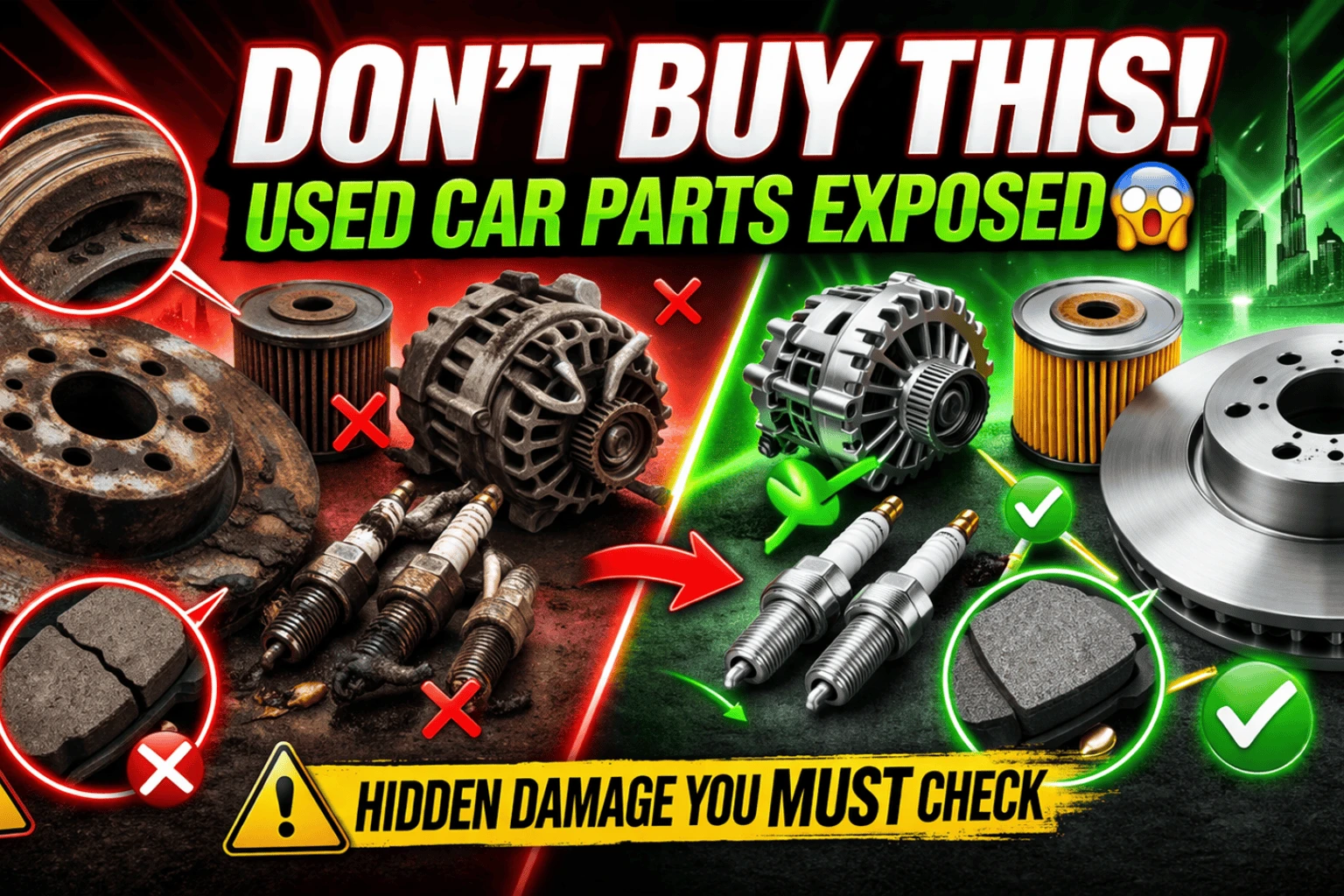
Reliable Second-Hand Car Parts: 10 Checks Every UAE Buyer Should Do.
To tell if a second-hand car part is reliable, start with five basics: confirm the exact part number, check compatibility with your car, inspect for physical damage and abnormal wear, test function where possible, and buy only from a supplier who offers clear sourcing details and return terms. In the UAE, this matters even more because heat, dust, poor storage, and imported salvage stock can shorten the life of some used parts.
Introduction
Used parts can save serious money, especially in 2026 when maintenance costs are higher, and many UAE drivers are keeping cars longer. But a low price is only a bargain if the part fits, works properly, and does not fail again after installation.
That is where most buyers get stuck. A part may look clean on the outside and still be the wrong fit, overheated, repaired badly, or near the end of its life.
This guide explains how to do a proper used car parts quality check, what to ask the seller, which parts are usually worth buying used, and when you should walk away. It also covers local buying realities in Sharjah, Dubai, and Ajman, so you can make a smarter decision before you pay.
Table of Contents
- What makes a second-hand car part reliable?
- How to inspect used auto parts step by step
- Which used parts are worth buying and which are not?
- Buying second-hand car parts in the UAE
- Common scams and mistakes to avoid
- When you should not buy used parts
- Myth vs. Fact
- What practical sourcing experience shows
- Frequently asked questions
- The smart way to buy used parts in 2026
Key Takeaways
- A reliable used part is not just cheap. It must match the correct part number, fit your vehicle, and still have useful service life.
- Visual condition matters, but function matters more. Ask for testing, startup videos, or bench-test proof when relevant.
- In the UAE, heat damage, poor storage, and mismatched imported parts are common reasons why used parts fail early.
- Body panels, mirrors, doors, and some OEM used car parts are often good used buys. Airbags, rubber parts, and some safety items usually are not.
- The best used spare parts suppliers UAE buyers trust are the ones who share donor details, photos, return terms, and honest condition notes.
What makes a second-hand car part reliable?
A reliable used car part fits the exact vehicle, has no hidden structural or electrical damage, shows normal rather than excessive wear, and can still do its job safely for a reasonable period.
That definition sounds simple, but in practice, it comes down to five signals.
The 5 core signs of a reliable used part
- Correct identity
The part number, revision code, and connector type match your vehicle. - Correct compatibility
It fits your model year, engine size, trim, transmission type, and market specification. This is a major issue with imported cars in the UAE. - Healthy physical condition
No cracks, warping, broken mounts, burnt connectors, deep rust, fluid contamination, or amateur repairs. - Provable functionality
The seller can show a bench test, startup video, resistance reading, scan result, or removal-from-running-car proof. - Transparent source
A trustworthy supplier can tell you what vehicle it came from, its general condition, and what return or exchange policy applies.
If one of these is missing, the risk rises quickly.
How to inspect used auto parts step by step
If you want a simple answer to “how to inspect used auto parts,” use this 10-step vehicle parts inspection checklist.
A 10-step used auto spare parts inspection checklist
- Check the exact part number first
Do not rely only on the car model name. Many parts differ by chassis range, engine code, trim, face lift year, or software version. A proper car parts compatibility check starts with the part number on the old component. - Match the vehicle details.
Confirm make, model, year, engine size, transmission, and VIN or chassis data if available. This matters for ECUs, gearboxes, sensors, lights, and suspension parts. - Inspect mounting points
Broken tabs, bent brackets, cracked housings, and repaired mounts often mean the part was stressed in an accident or removed roughly. - Look for heat and age damage.e
In the UAE, heat is hard on plastics, rubber, wiring insulation, seals, dashboards, and electronics. Faded plastic, brittle clips, and hardened seals are warning signs. - Check for leaks, rust, and contamination.
Oil stains, coolant residue, transmission fluid seepage, corrosion inside connectors, or water marks can mean internal damage. - Study wear patterns
Uneven wear tells a story. A pulley that wobbles, brake hardware with grooves, a bushing with torn edges, or gears with metallic debris all suggest limited remaining life. - Test the function if possible.
Ask for a bench test on alternators, starters, AC compressors, window motors, and modules. For electronic parts, verify connector pins are straight and not heat-burnt. - Ask about the donor vehicle.
Low, medium, or high mileage is less useful than an honest donor condition. Was the vehicle crashed, flooded, overheated, or dismantled after a mechanical failure? - Check return terms before paying.g
Good sellers reduce your risk with a written exchange or test warranty. No-return sales are much riskier, especially for electrical items. - Have critical parts checked by a technician
For brakes, suspension, steering, engines, gearboxes, airbags, or electronic control modules, professional inspection is worth the cost.
Special checks for the used engine and gearbox inspection
Engines and gearboxes deserve extra caution because the part may be cheap, but the labour to fit it is not.
For a used engine, check:
- compression or leak-down results, if available
- oil cap, sludge,e or metal particles
- signs of overheating
- cracked manifolds or broken sensors
- a cold-start video, not only a warm engine video
For a used gearbox, check:
- fluid colour and burnt smell
- damage around mounts and casing
- selector movement
- metal filings in drainedoilo, if available
- shift proof from a running donor vehicle when possible
Special checks for electrical parts
Electrical and electronic parts often fail from hidden causes. For an ECU, ABS module, fuse box, or sensor, verify:
- exact matching part number
- no broken pins or moisture marks
- no burnt smell
- correct coding or immobiliser requirements
- seller testing history
A clean-looking module that does not code correctly to your vehicle is still the wrong part.
Which used parts are worth buying and which are not?
Not every part carries the same risk. This is where a second-hand auto parts guide should be practical, not vague.
| Part type | Usually okay to buy used? | What to inspect | Better to buy new when |
| Doors, mirrors, fenders, bumpers | Yes | Paint damage, dents, tabs, rust, and colour match | If repair and repaint costs erase the savings |
| Headlights and taillights | Often yes | Cracks, moisture inside, broken mounts, and yellowing | If the lens is badly faded or the electronics are weak |
| Alternator, starter, AC compressor | Sometimes | Bench test, pulley noise, connector condition, warranty | If no testing or no return policy |
| Engine and gearbox | With caution | Compression, leaks, fluid condition, startup proof, donor details | If the origin is unclear or the labour cost is high |
| Seats, trim, dashboard parts | Often yes | Tears, broken clips, sun damage, smell | If airbag-integrated components are involved |
| Suspension arms, steering racks | With caution | Play, bent metal, bush wear, leaks | If the safety risk is high, or wear is advanced |
| ECUs, sensors, modules | With caution | Exact number match, coding needs, pin condition, and moisture | If the software version is unknown |
| Brake pads, discs, airbags, seat belt pretensioners | Usually no | Safety history is hard to verify | Buy new or specialist-verified only |
| Hoses, belts, seals, rubber mounts | Usually no | Heat hardening and cracking are common | Buy new |
A simple rule helps: the lower the safety risk and the easier the inspection, the better the used-buy case. The higher the safety risk or labour cost, the more careful you should be.
Buying second-hand car parts in the UAE
Buying second-hand car parts in the UAE buyers can trust is less about location alone and more about sourcing discipline.
What changes in the UAE market
The UAE has a strong availability of recycled auto parts that UAE buyers want, especially for Japanese, Korean, and common European models. Sharjah Industrial Area remains a major hub for used spare parts. Dubai offers access and convenience, often with more organised retail sellers. Ajman dismantlers can be useful for specific models and price-sensitive sourcing.
But local conditions matter:
- Heat exposure can shorten the life of plastics, rubber, seals, and electronics.
- Dust and outdoor storage can affect bearings, connectors, and interior trim.
- Imported salvage vehicles may carry hidden crash or water damage.
- Mismatched market specs can create fitment problems, especially with US, GCC, Japanese, and European variants.
If you want to compare online listings before visiting suppliers, browse Used Car Parts in the UAE so you can filter by vehicle, match part numbers, and ask sellers the right questions before making the trip.
How to judge the used spare parts suppliers that UAE buyers deal with
A trusted supplier should be willing to provide:
- clear photos from multiple angles
- the exact part number or label close-up
- donor vehicle details if known
- test proof for electrical or mechanical parts
- invoice and exchange terms
- honest notes about flaws, repairs, or missing pieces
That matters whether you buy from auto dismantlers, UAE workshops that use regularly, a Sharjah trader, or an online platform.
Real buying scenarios
Scenario 1: Older sedan, damaged mirror
A used OEM mirror from Sharjah is often a smart buy. Fitment is easy to confirm, risk is low, and savings are meaningful.
Scenario 2: SUV with gearbox failure
A cheap gearbox without donor proof is often a false economy. Even if the part price is attractive, labour, fluid, coding, and reinstall costs make failure expensive.
Scenario 3: Fleet vehicle needing lights and trim
Buying multiple low-risk parts used can make sense, but only after one sample part passes an automotive parts condition check.
Common scams and mistakes to avoid
Most bad purchases are not dramatic fraud. They are avoidable shortcuts.
Watch for these red flags
- Fresh paint hides cracks or repairs
- Broken tabs photographed from the wrong angle
- “Same same” fitment claims without part number proof
- No-return policy on untested electrical parts
- Engine sold as low mileage with no evidence
- Gearbox sold without a fluid check or startup proof
- Mixed trim or market-spec parts that almost fit, but do not
The most common buyer mistakes
- Buying by model only, not by part number
- Choosing the cheapest option without checking the labour risk
- Ignoring storage condition
- Assuming OEM use is automatically better than any aftermarket part
- Installing a questionable part just because the seller says it worked before removal
Cheap used car parts UAE searches are common, but the real cost is part price plus fitting time plus the chance of doing the job twice.
When you should not buy used parts
There are times when the correct decision is to walk away.
Do not buy used if the part is safety-critical, heavily wear-dependent, or impossible to verify properly.
That often includes:
- airbags and pretensioners
- brake pads and discs
- old hoses, belts, seals, and rubber mounts
- badly rusted suspension parts
- electronics with broken housings or moisture damage
- engines and gearboxes with unknown origin and no testing proof
Also, avoid used parts when the labour to replace them is high. A questionable turbocharger, gearbox, or timing-related component can wipe out any initial savings.
Myth vs. Fact
Myth: If a used part looks clean, it is reliable.
Fact: Cosmetic cleaning is easy. Fitment, wear, and internal condition matter more.
Myth: OEM used parts are always better than new aftermarket parts.
Fact: A good OEM used part can be excellent, but a worn or heat-damaged OEM part may be worse than a quality new aftermarket option.
Myth: The cheapest seller gives the best deal.
Fact: The best value comes from the part that works the first time correctly and does not create repeat labour.
Myth: All parts from dismantlers are risky.
Fact: Many dismantlers and used spare parts suppliers in UAE workshops can be dependable if they document source, testing, and return terms well.
What practical sourcing experience shows
In real UAE sourcing work, the best outcomes usually come from boring discipline, not luck. Verify the number, inspect the condition, ask how the part was stored, and get written return terms. Across Sharjah Industrial Area, Dubai sellers, and Ajman dismantlers, the same pattern keeps showing up: buyers who rush for price often pay twice, while buyers who confirm fitment and testing first usually get far better value.
Practical experience also shows that the UAE climate matters more than many buyers realise. Sun-baked plastics, hardened seals, and outdoor-stored electronics are common. A part can be genuine and still be a poor buy.
Frequently asked questions
How do you check if a used car part is reliable?
Check the part number, confirm compatibility with your vehicle, inspect for cracks, leaks, rust, burnt connectors, and broken mounts, then ask for a function test or startup proof. Finally, buy only from a seller who explains the source and offers clear return terms.
Is it safe to buy a used engine or gearbox in the UAE?
It can be, but only with extra checks. Ask for donor details, compression or startup proof, fluid condition, and signs of overheating or impact damage. Because the installation cost is high, a technician should inspect the unit before you commit.
Are OEM used car parts better than aftermarket parts?
Not automatically. A good OEM used part often fits better than a cheap aftermarket one, especially for body panels, mirrors, and trim. But if the OEM used part is worn, heat-damaged, or near end-of-life, a quality new aftermarket part may be the better choice.
Which used car parts should usually be avoided?
Avoid or be extremely cautious with airbags, pretensioners, brake wear items, old rubber components, damaged electronic modules, and any major mechanical part with no clear testing history. Safety-critical items should generally be bought new or specialist-verified.
Where can I buy reliable used auto parts that UAE buyers trust?
Start with established suppliers in Sharjah Industrial Area, Dubai auto parts markets, and Ajman dismantlers with clear testing and exchange policies. Online platforms can also help if listings show part numbers, detailed photos, and seller contact transparency.
What matters more, mileage or visible condition?
Both matter, but neither tells the full story alone. A lower-mileage part stored badly in the UAE heat can be worse than a higher-mileage part removed carefully and stored indoors. The best decision uses part number match, condition, test proof, and seller transparency together.
The smart way to buy used parts in 2026
Reliable second-hand car parts are absolutely worth considering in the UAE, but only when you treat the purchase like an inspection job, not a bargain hunt. The essentials are simple: verify the part number, confirm compatibility, inspect condition carefully, test where possible, and buy from a supplier who is transparent about source and return terms.
For low-risk items like mirrors, doors, lights, and some trim, used can be a very smart option. For engines, gearboxes, electronics, and safety-critical parts, caution matters more. As the UAE's used parts industry grows and more listings move online, buyers who use a real checklist will make better decisions than buyers who shop on price alone.
If you are about to buy, take the next practical step: shortlist two or three suppliers, send them your exact part number, ask for detailed photos and test proof, and compare value, not just price.